
Control the deformation of loader bucket main shovel from the manufacturing source:
Usually, the front end of the loader bucket is installed with a loader bucket adapter, loader bucket teeth, fixed with welding or bolts. In the process of loader bucket manufacturing, the main blade often appears arch, fall, distortion and other deformation. In order to ensure the flatness of the main blade, we use hydraulic molding machine, which not only extends the production cycle, but also increases the production cost. In addition, the internal stress of the main blade is increased. Therefore, we analyze the structure and production technology of the bucket, find out the cause of main blade deformation, and formulate the corresponding preventive measures.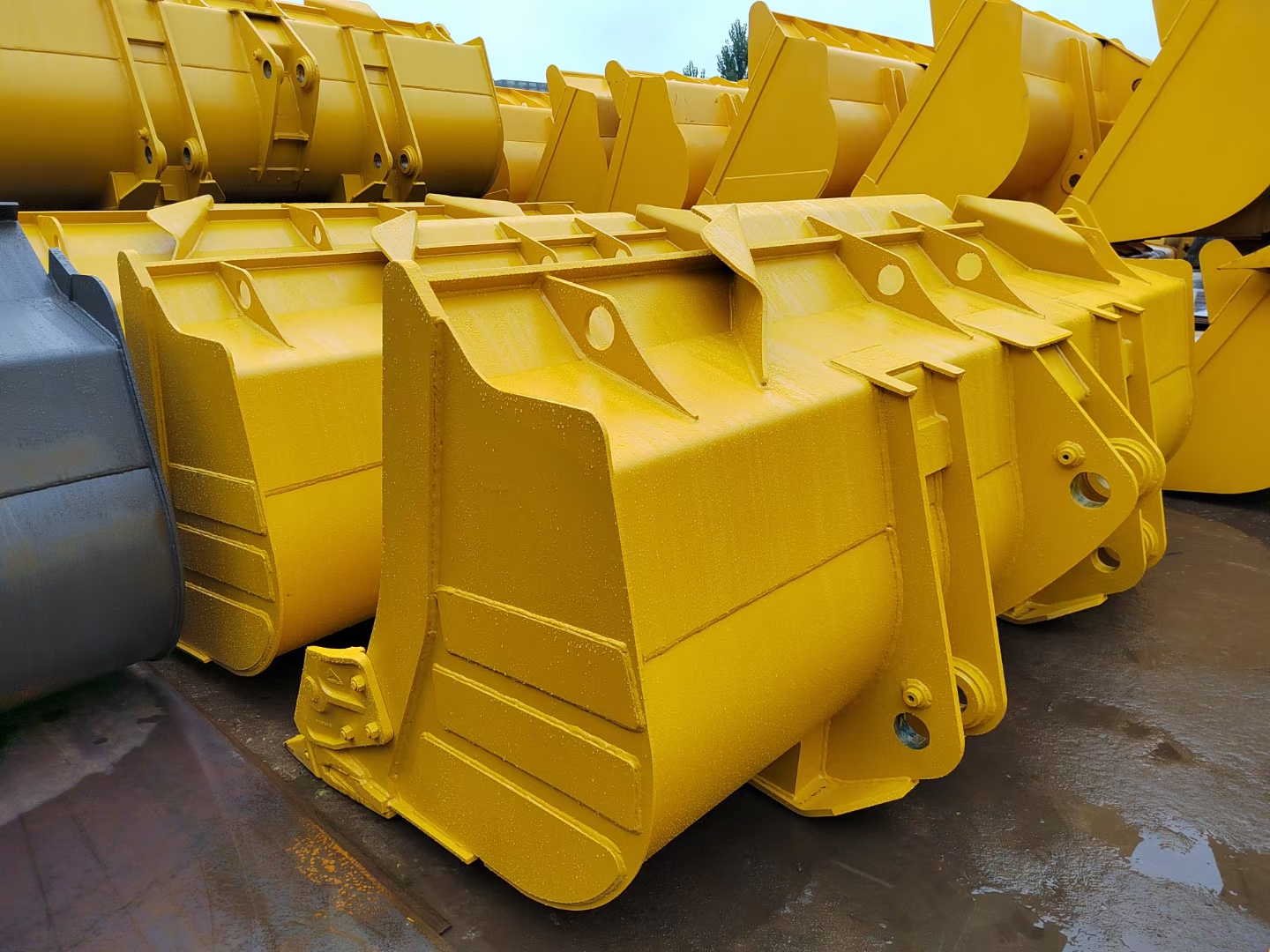
(1) Management reasons The main blade of the bucket is an external machined part after material cutting. As a result of plate loading and unloading, transportation and storage, the main blade arch and collapse phenomenon. And flexural deformation. For the first two kinds of deformation, the plate can be leveled on the hydraulic press before the bucket welding, but the bending deformation is difficult to adjust, so as to be used in the later assembly welding process.
(2) Design reasons the bottom weld of the bucket is mainly concentrated in the back, the weld is dense, the weld form is unreasonable, so the welding workload and heat input is quite large. The bucket structure and back welding arrangement are shown in Figure 1.
At the same time, due to the deflection of the main blade, the gap between the main blade and the bucket bottom and bucket wall increases and is not uniform. When each part is assembled according to the drawing, the middle part of the docking gap is 10mm, which shall be measured separately. At 3mm, the gap between the two ends is ≥18mm, with an average of 11mm (see the long dashed line in the weld layout on the back of the bucket in FIG. 1). The increase of butt clearance increases welding workload and welding heat input. The uneven gap makes the welding heat input is not uniform, the cold shrinkage deformation after welding is not uniform, so that the weld after cooling bucket. The bottom plate, bucket wall plate and guide plate have corresponding welding deformation.
(3) The welding process of the bucket assembly is divided into three steps: 1 bucket wall coil; 2. The wall of the bucket is welded with the side plate of the bucket, and the main shovel, the bottom plate of the bucket, the supporting plate and the tire set are welded with the bucket; 3 welding. These three steps are independent and do not interfere with each other.
When the side plate is rolled, the main tool is deformed due to the uneven force at both ends or the pressing line is not parallel to the side wall of the slab. As shown in FIG. 2, after the main blade is spliced, the main blade is twisted. .
When the bucket bottom plate is laid, because the bucket bottom plate is uneven or other reasons, the bucket bottom plate is higher than the bucket side plate or the bucket main blade, the flat panel formed by the main blade and the two bucket side plates are damaged, and the bucket cannot be placed after the bucket is welded. Flat, resulting in the welding deformation of the main blade by mistake, as shown in Figure 1, the local high point marked in the bucket structure diagram.
When welding the bucket, from the point of view of reducing the welding deformation, no welding, welding according to the welding process sequence, uniform and symmetric welding, especially the wall and the bottom of the butt weld of the main blade and the bucket. As a result, the welding heat input is excessively concentrated, and the front and back welding deformation cannot cancel each other, and the main blade plate is deformed due to welding, as shown in the long dashed line in FIG. 1.
In this way, the errors and welding deformation generated by each step are concentrated together, so that the main blade will be deformed after the bucket welding.
2 Measures to prevent deformation of the bucket main blade (1) strengthen the management of the bucket main blade and return to the factory, the flatness does not meet the requirements of flatness. For bending deformation, butt panel. The blade is cut by semi-automatic flame cutting machine to ensure that the blade is straight after machining.
(2) Improve the design, the gap between the bottom plate and the main blade is reduced, from the original 10mm to 5mm, remove the 5mm clearance of the bucket side plate, and the middle long round hole continuous seam welding bucket wall and wall plate distribution is uniform. Round hole discontinuous weld, see FIG. 4 for specific improvement.
Through the above improvements, the welding heat and welding workload can be greatly reduced, so that the welding heat is uniform but not concentrated, so as to reduce the main blade and welding deformation.
(3) Improve the construction quality in the process of winding, to ensure that the molding line and both sides of the bucket wall parallel, both ends of the bucket wall force uniform, prevent deformation; When the bottom of the bucket is laid, the bottom of the bucket is flat and not higher than the two sides. The plane formed by the side plate of the bucket and the main blade; The welding bucket should be welded as evenly as possible, especially the butt weld between the main blade and the bottom of the bucket and the wall of the bucket should be welded separately to reduce the welding heat input. And the concentration degree of welding heat input, so that the welding deformation of the front and rear welds cancel each other. The specific welding sequence is shown in Figure 4.
In these three steps, the influence of the main blade deformation caused by construction factors is minimized, thus reducing the post-welding deformation of the main blade.


